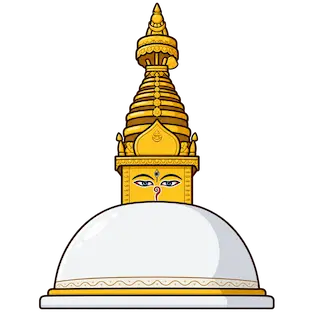
The Swayambhu stupa Swayambhu Purana
A stupa on a golden lotus rising from the lake, with the Himalaya behind.

स्वयम्भू पुराण

Swayambhu Purana As It Is

The origin of the Kathmandu Valley, as told by the Buddha.

About the Text

Long before there was a valley, there was a lake. The Swayambhu Purana opens on that water, and on a flame that rose out of it by itself (swayambhu, self-arisen) on a jewelled lotus in the middle of the lake that filled what is now Kathmandu. The text follows that light through the ages: how the bodhisattva Mañjuśrī cut the hills open with his sword and let the water out, how the drained valley was settled and named, how a stone was finally laid over the flame to protect it, and how the stupa that stands on the hill today came to be built above it.

It is told as a set of stories inside stories. A bodhisattva asks a teacher a question; the teacher answers by recalling what Emperor Aśoka once asked his teacher; and that answer reaches back further still, to the Buddha himself speaking on the Swayambhu hill about an age so distant that the valley was still under water. The narrators change, but the subject does not.

For Newar Buddhists of the Kathmandu Valley this is the founding account of the land, of the shrines still visited today, and of Buddhism’s arrival in that landscape. It is a sacred history and a geography at once: many of the places it names are places you can still walk to.

This edition gives the original Sanskrit text as it is, translated closely rather than smoothed into paraphrase.

श्रीमता येन सद्धर्मस्त्रैलोके संप्रकाशितः ।
श्रीघनं तं महाबुद्धं वन्देकऽहं शरणाश्रितः ॥ १.१ ॥

śrīmatā yena saddharmastrailoke saṁprakāśitaḥ ।
śrīghanaṁ taṁ mahābuddhaṁ vandeka'haṁ śaraṇāśritaḥ ॥ 1.1 ॥

English

By whom the supreme Dharma was illuminated in the three worlds,
I bow to that glorious, supreme Buddha, who is my refuge and shelter.

नेपाली

जसले तीनै लोकहरूमा परम धर्मलाई प्रकाशित गर्नुभयो,
म त्यो महाबुद्धलाई प्रणाम गर्छु, जो मेरो शरण र आश्रय हुनुहुन्छ।

Purport

The poem opens the way almost every Sanskrit work of this age opens, with a bow. Before telling us anything about Swayambhu, the poet stops to honour the Buddha, called here Śrīghana, 'the Dense Mass of Glory', as the one who lit up the true teaching across heaven, earth and the underworld. Calling the Buddha his shelter is the poet's way of saying that this is not his story, and that he is only carrying it.

Chapter one, verse one, as every verse appears.

The Ten Chapters

1,749 Verses

Chapter 1 The Origin of Swayambhu This is the first chapter of the Swayambhu Purana, the old account of how a self-arisen flame appeared on a hill above what is now the … 171 verses Chapter 2 The Fruits of Worshipping Swayambhu This is the second chapter of the Swayambhu Purana. The Buddha, asked by Maitreya to continue the story, describes the age of Śikhi Buddha, … 181 verses Chapter 3 The Draining of the Great Lake This is the third chapter of the Swayambhu Purana, and the one that tells how the Kathmandu Valley came to exist. In the age of Viśvabhū … 203 verses Chapter 4 The Eight Vitaragas and the Founding of the Realm This is the fourth chapter of the Swayambhu Purana, and it tells how the drained valley became a country. In the age of Krakucchanda Buddha, … 172 verses Chapter 5 The Many Holy Fords and Their Merit This is the fifth chapter of the Swayambhu Purana, and it maps the water of the Kathmandu Valley. Chapter four ended by telling the people … 149 verses Chapter 6 The Naming of Dharmadhātu Vāgīśvara This is the sixth chapter of the Swayambhu Purana, and the one with the best story in it. Maitreya asks why Swayambhu is also called … 195 verses Chapter 7 The Concealment of Dharmadhātu Vāgīśvara This is the seventh chapter of the Swayambhu Purana, and it answers the question chapter one left hanging: who covered the self arisen light … 198 verses Chapter 8 The Rite for Good Rain This is the eighth chapter of the Swayambhu Purana, and it is the poem’s hardest look at what a bad ruler costs a country. A young king … 228 verses Chapter 9 The Greatness of Shantikar This is the ninth chapter of the Swayambhu Purana, and it is the shortest so far. Maitreya asks a question about a word: when and how did … 82 verses Chapter 10 The Greatness of the Dharma of Swayambhu This is the tenth and last chapter of the Swayambhu Purana, and it brings the whole book home. The Buddha finishes his teaching on the hill … 170 verses

A Note on the Translation

I began this translation because the Swayambhu Purana is a text that belongs to the Kathmandu Valley, and yet most people who live there have never been able to read it. The Sanskrit is difficult, and the summaries that circulate flatten a strange, layered, patient poem into a few sentences about a lake and a sword.

So I have tried to give the whole thing, as it is, and to give it more than once: the Sanskrit as it stands, a transliteration for those who can sound it out but not read the script, a literal English rendering that resists tidying the text up, a Nepali translation, and a purport for the many places where a verse assumes knowledge a reader today simply does not have.

Errors that remain are mine.